
TPRM in the Age of AI Is Already Hard. Your Vendor Oversight Doesn’t Have to Be.
For years, Third-Party Risk Management (TPRM) in financial services followed a familiar playbook: onboard the vendor, send the questionnaire, review the controls, and revisit the relationship annually. Unfortunately, that model no longer reflects reality.

Banks, insurers, and financial institutions now operate inside vast digital ecosystems powered by cloud platforms, APIs, AI models, outsourced operations, fintech integrations, and globally distributed supply chains. A single business service may depend on dozens—or hundreds—of interconnected providers operating far beyond direct contractual visibility.
The result is a new kind of risk landscape. One where cyber exposure, operational resilience, concentration risk, data governance, regulatory compliance, and AI accountability are no longer separate disciplines. They are converging into a single ecosystem challenge.
And what’s more? AI’s rapid evolution has moved it from a tool that institutions use internally to now a third party itself.
This accelerated pressure on TPRM administrators and practitioners has pushed vendor management to the extreme.
“Today, financial institutions rely on external large language models, AI-driven fraud engines, decisioning platforms, autonomous agents, and predictive analytics providers to support critical operations,” said Joe Scarlato, EVP Ampcus Forensics. “As a certified fraud examiner, I see it all the time. These systems introduce entirely new categories of risk: model integrity, hallucination risk, biased outcomes, opaque decision-making, synthetic identity fraud, and evolving regulatory scrutiny. Traditional TPRM frameworks were never designed for this.”
“Boards are asking a harder question now,” said Doug Bogle, Sales Director at Ampcus Cyber. “It’s not ‘are our vendors secure?’ but ‘do we actually understand how a breach two or three layers deep in our supply chain reaches us?’ That visibility — across cyber, AI, and operational dependencies — is what separates institutions that survive a third-party incident from those that get pulled under by it.”
Static assessments and point-in-time questionnaires cannot keep pace with environments where vendor dependencies change daily, AI models continuously evolve, and fourth- and nth-party relationships create hidden pathways for systemic disruption.
The next generation of TPRM requires something fundamentally different: continuous, predictive, intelligence-driven oversight.
Three Emerging Use Cases Reshaping BFSI TPRM
“Our financial institutions clients operate deeply interconnected ecosystems,” Raj Narayan, SVP, BFSI at Ampcus says. “Traditional suppliers, AI models, cloud infrastructure providers, fintech platforms, data aggregators, payment processors, and outsourced operations are exchanging data and support critical business services in real time. We see three primary uses cases emerging.”
Al-Powered Fraud Detection Creates New Model Risk Exposure
A global bank adopts an external Al platform to accelerate fraud detection improving speed dramatically. But the model was trained on incomplete regional datasets, leading to inconsistent risk scoring and regulatory concerns around fairness and explainability. The Al provider’s own cloud vendors and data aggregators were never fully mapped during onboarding.
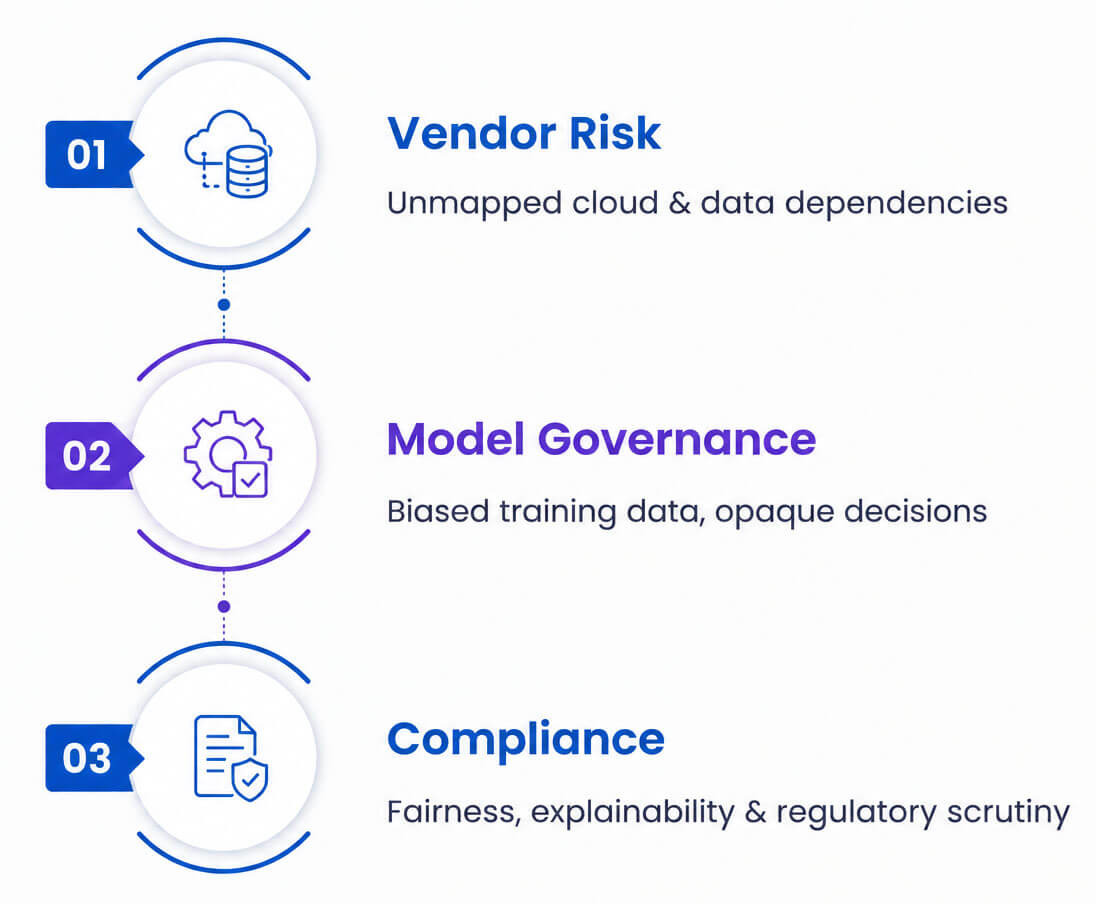
BFSI leaders must now evaluate Al model integrity, data lineage, decision transparency, and full ecosystem resilience – not just vendor security posture.
Fourth-Party Concentration Risk Disrupts Critical Banking Operations
A regional outage at a major cloud provider cascades across multiple fintech and payment-processing partners – simultaneously. Even institutions that diversified direct vendors discover those vendors share the same underlying infrastructure. Payment delays spike. Regulators demand operational resilience reporting. The TPRM program had no real-time visibility into fourth- and nth-party dependencies.
Cloud Concentration
A handful of hyperscalers underpin most fintech infrastructure — one failure hits many institutions at once.
Ecosystem Blind Spots
Contractual TPRM misses systemic interconnectedness across digital supply chains.
Ecosystem Intelligence
TPRM must evolve to map nth-party dependencies and identify systemic risk before disruption occurs.
Al-Accelerated Cyber Threats Outpace Traditional Assessments
A vendor passes its annual security audit with strong results. Six months later, attackers use generative AI to launch sophisticated phishing campaigns, compromising privileged credentials tied to multiple financial clients. Annual review cycles offer little protection against rapidly evolving Al-driven attack patterns.
Threat actors scale phishing, credential theft and social engineering faster than governance cycles can respond.
Leading institutions deploy AI for anomaly detection, automated control validation and predictive risk intelligence.
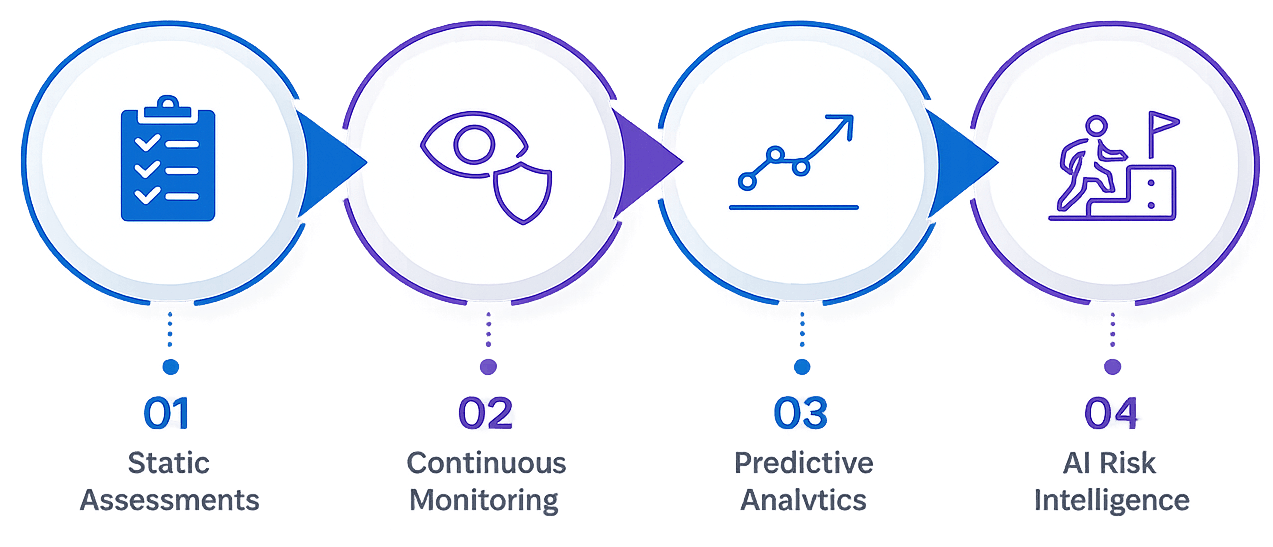
The shift from static compliance exercises to continuous, Al-enabled monitoring is no longer optional – it is the defining capability separating resilient institutions from vulnerable ones. Share this post if your organization is rethinking its TPRM and cyber strategy.
“The expanding and increasingly opaque operating model is forcing our clients to confront the reality of fourth- and nth-party risk,” Narayan said. “The challenge is no longer limited to understanding direct vendor relationships. As these environments become too complex for manual oversight and static assessments alone, AI-enabled TPRM systems capable of continuously monitoring ecosystems, mapping interconnected dependencies, detecting emerging risk signals, and providing predictive intelligence in near real time will become the foundation for resilient, intelligence-driven risk management in the digital economy.”
From Vendor Management to Ecosystem Resilience
The institutions that succeed in 2026 and beyond will move TPRM beyond a procurement or compliance function. They will view it as a strategic resilience capability.
“The financial services CISOs I work with are wrestling with the same gap,” Bogle said. “Their TPRM program was built to evaluate vendors, but their real exposure now sits in AI models, fourth-party APIs, and shared cloud infrastructure that no questionnaire was ever designed to assess. Closing that gap — with continuous monitoring, intelligence, and cyber controls that follow the data — is the work ahead of us.”
That means transitioning from spreadsheets, annual questionnaires, and siloed oversight toward dynamic ecosystem visibility across vendors, AI systems, supply chains, cyber exposure, and operational dependencies.
It also means redefining accountability. Boards, risk leaders, cybersecurity teams, procurement organizations, and operational resilience functions must work from a shared understanding of interconnected risk.
“The future of TPRM is not about managing vendors,” Scarlato said. “It is about understanding how interconnected ecosystems behave under stress—and building the intelligence, visibility, and resilience to respond before disruption spreads.”
These are the conversations reshaping BFSI risk leadership right now, and they will define the next era of operational resilience.
In our session this month at GFMI in New York (“TPRM in the Age of AI: From Vendor Oversight to Ecosystem Intelligence — 2026 and Beyond”), Scarlato explored how leading institutions are preparing for this shift and what practical steps organizations can take today to modernize TPRM for the realities ahead.