
How AI-Powered Intelligent Automation Is Changing Enterprise Workflows in 2026
The best organizations are building systems that think, decide, and move while their business moves.
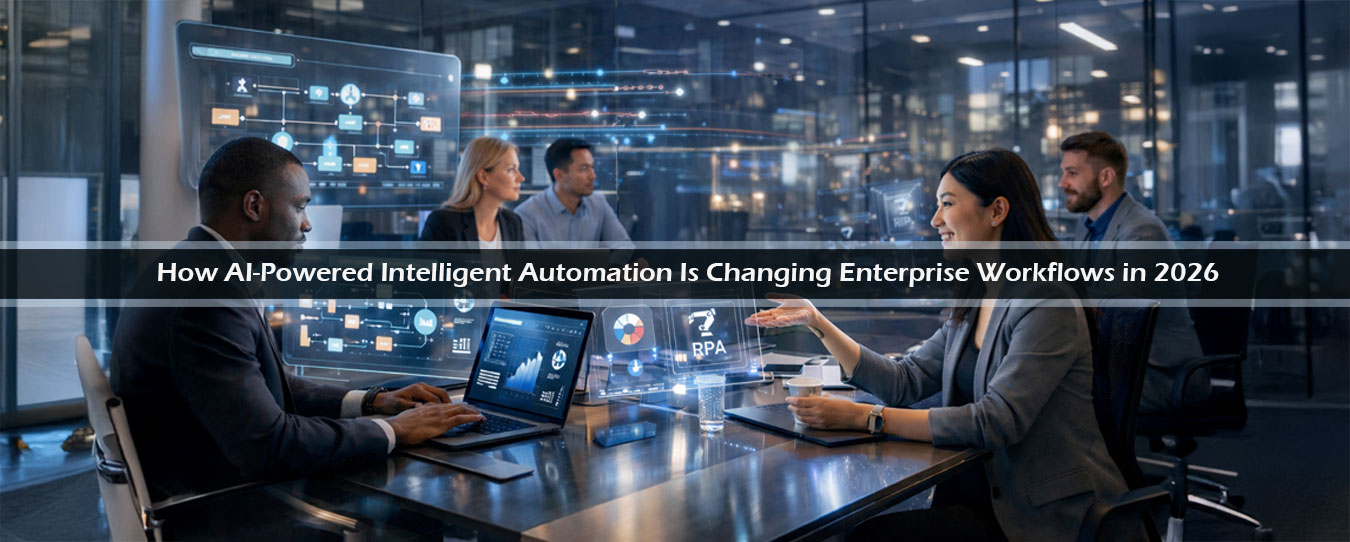
In 2026, a quiet revolution is reshaping the world’s largest organizations. And it isn’t just faster software or cleaner dashboards. That’s table stakes.
No, the revolution now is a re-imagination of workflows – intelligently orchestrated, self-guided, and able to adapt in real time.
For years, enterprise workflows were rigid and slow, built for a predictable world. That world no longer exists. Today, AI understands context, learns from data, and acts at machine speed. Intelligent automation has become the new operating system of the enterprise.
And the organizations pulling ahead aren’t simply cutting costs. They are building systems that think, decide, and move while the business moves. This is not a change on the horizon.
This is the moment work evolves.
What Is AI-Powered Intelligent Automation in 2026?
AI-powered intelligent automation in enterprise workflows is the convergence of AI, automation, and orchestration that creates adaptive, decision-aware workflows able to sense, decide, and act with minimal human intervention.
Unlike traditional RPA that follows static rules, intelligent automation in 2026 uses machine learning, generative AI, and AI agents to learn from data, adjust in real time, and coordinate end-to-end processes across systems and teams. This is the turning point where workflows stop being scripted and start becoming autonomous business processes that optimize themselves.
How AI is Transforming Workflows in 2026
AI turns workflows from linear checklists into living systems that understand context, learn from every run, and improve over time.
In 2025, 79% of enterprises reported using AI in at least one business function, signaling that intelligent automation is moving from experiments to core operations. Generative AI and agentic AI now orchestrate multi-step processes such as planning tasks, calling APIs, talking to users, and triggering downstream automations, while embedded models make real-time decisions on routing, approvals, and risk.
What to Know About the Core Technologies Powering Intelligent Automation
Under the surface, several technologies are doing the heavy lifting.
- Generative and agentic AI handle autonomous task execution, from drafting documents to coordinating workflows across finance, IT, and customer channels.
- Process mining and process intelligence map how work truly flows, revealing bottlenecks and “dark work” so AI can target the right steps.
- Low-code and no-code platforms let business teams design workflows while AI suggests optimizations, making automation a shared capability, not just an IT craft.
- Governance, explainability, and human-in-the-loop controls ensure AI decisions stay auditable and compliant as more authority moves from people to algorithms.
Which Workflows Are Being Redefined?
The shift here is not abstract. Specific enterprise workflows are being rebuilt around AI-powered intelligent automation:
- Finance, audit, and compliance
- Continuous auditing uses AI to scan every transaction, not random samples, catching anomalies in real time instead of quarter-end.
- Intelligent compliance engines monitor policy, regulatory updates, and control breaches automatically, reducing manual review cycles.
- IT operations and infrastructure
- AIOps platforms pair AI with automation to deliver self-healing systems and predictive maintenance, cutting unplanned downtime and support tickets.
- Hybrid and multi-cloud orchestration automates provisioning, scaling, and failover across environments, guided by real-time performance signals.
- Cybersecurity and risk management
- AI-driven threat detection correlates signals at machine speed, while automated incident response runs playbooks within seconds, not hours.
- Risk-based workflow orchestration routes incidents based on criticality, impact, and business context, so teams focus on where it truly matters.
- Testing, validation, and verification (TV&V)
- AI-led test automation generates test cases, executes them continuously, and adapts to code changes, embedding quality into DevOps pipelines.
- Continuous validation reduces release risk and accelerates time-to-market without trading off reliability.
- Forensic accounting and fraud investigations
- AI searches for subtle anomalies across millions of records and links entities to surface fraud patterns humans would miss.
- Automated evidence correlation speeds investigations, shrinking cycles from weeks to days while improving accuracy.
- HR, talent, and staffing
- Skills-based planning engines match roles to capabilities, not just titles, helping leaders close gaps faster.
- Intelligent onboarding workflows automate paperwork, training paths, and compliance checks, creating a smoother first experience for new hires.
What Leaders Should Expect from Intelligent Automation in 2026
- Autonomous AI Agents – Self-directed agents that plan, execute, and optimize workflows end-to-end.
- Self-Healing Automation – Systems that detect failures, adapt logic, and auto-correct without human intervention.
- Generative AI–Driven Process Design – AI that designs, tests, and improves workflows from natural language prompts.
- Hyper automation Platforms 2.0 – Unified orchestration of RPA, AI, analytics, and low-code at enterprise scale.
- AI-Native Decision Automation – Real-time decisions powered by predictive, causal, and prescriptive intelligence.
- Human-in-the-Loop AI by Default – Built-in governance, explainability, and control for regulated automation.
- Edge + Intelligent Automation – Autonomous operations at the edge for manufacturing, telecom, and logistics.
- Industry-Specific Autonomous Systems – Pre-trained automation for finance, healthcare, legal, and insurance.
- Secure-by-Design Automation – Embedded zero-trust, policy-aware, and compliant automation.
- AI-Orchestrated Digital Workforces – Dynamic coordination of humans, bots, and agents as a single workforce.
Business Benefits Leaders Care About
The data is pretty blunt: intelligent automation in 2026 is already separating leaders from laggards.
For example, Redwood’s Enterprise Automation Index shows 73% of companies increased automation investment last year, with 36.6% reporting at least 25% cost reductions and 48.6% seeing efficiency gains of 25% or more. Workflow automation overall is on track to reach nearly USD 87.7 billion by 2032, growing at around 16–21% CAGR, as enterprises chase faster decisions, lower risk, and higher productivity.
For employees, intelligent automation is not about replacement; it is about liberation. Studies on business process automation in 2025 show that intelligent automation can fully automate up to 69% of managerial work and make self-service automation available to 88% of employees, freeing them for higher-value judgment, creativity, and relationships.
How to Implement Intelligent Automation Now
The leaders who win this decade will not be the ones with the most AI pilots; they will be the ones who turn AI into a new way of working. Here’s our recommendations:
- Start by identifying AI-ready workflows where rules, volume, and data are already in place—finance close, incident management, onboarding, claims, or order-to-cash.
- Build a scalable roadmap that links automation initiatives to business outcomes, not just technology milestones, then phase in AI workflow automation for enterprises where risk is manageable and value is visible.
- Avoid common pitfalls: isolated pilots, lack of governance, and ignoring change management; surveys show that fewer than 6% of businesses have reached end-to-end autonomous automation in any core process, mainly due to these barriers.
Governance, Ethics, and Trust in AI Workflows
As AI agents gain more authority in enterprise AI automation solutions, trust becomes an architectural requirement, not an afterthought.
Gartner reports that only about 15% of IT leaders are piloting fully autonomous AI agents today, largely because of concerns over governance and control. Strong AI governance frameworks, covering explainability, fairness, auditability, and human override, turn that fear into confidence and make regulators partners instead of roadblocks.
As an ISO 42001 certified organization, Ampcus is committed to responsible AI development. And we believe governance is not a feature. It’s a gate.
2026 Intelligent Automation Architecture
Behind every autonomous business process sits a clear, disciplined architecture.
- A data integration and orchestration layer connects ERPs, CRMs, security tools, clouds, and edge systems into a single nervous system.
- AI, ML, and GenAI services provide the intelligence—insights, predictions, language understanding, and agentic planning.
- Workflow automation engines execute and monitor processes, embedding rules, policies, and human checkpoints where needed.
- Security and compliance frameworks wrap everything in identity, access, logging, and continuous controls so audits are built in, not bolted on.
From Intelligent Automation to Autonomous Enterprises
In 2026, AI-powered intelligent automation isn’t optional, it’s the edge that turns good enterprises into unstoppable ones. Early adopters are already gaining 25%+ efficiency and slashing costs, leaving hesitation behind.
Ready to assess your workflows today? The Ampcus AI team can help you understand, redesign, deploy, and grow with intelligent automation solutions built for your business and your goals. Contact us now for a consultation.